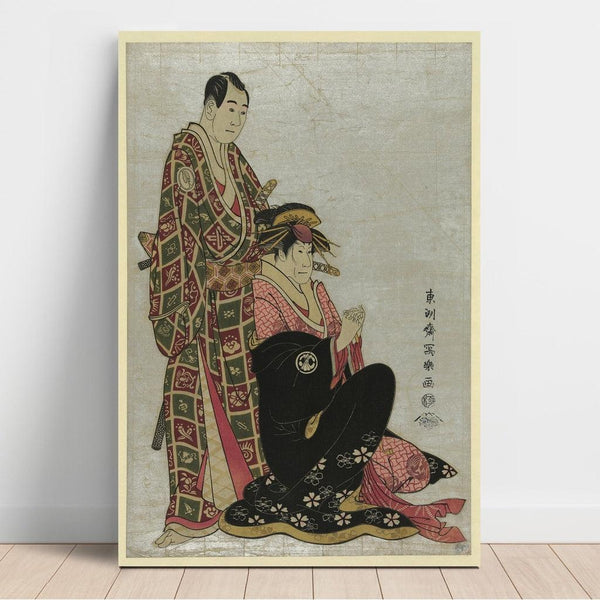
Few artists have left so profound a mark in so brief a span of time as Tōshūsai Sharaku. Active for only some ten months, between 1794 and 1795, this Japanese printmaker nonetheless ranks among the most singular figures of ukiyo-e, the art of the print that flourished during the Edo period. His portraits of kabuki actors, of rare psychological intensity, continue to fascinate enthusiasts and art historians alike. Behind this concentrated body of work stands a creator whose identity remains uncertain, something that has only added to the aura surrounding his name.
An enigma in the history of art
Tōshūsai Sharaku occupies a place apart in the history of Japanese printmaking, in large part because so little is known about his life. His work appears suddenly in 1794, published by the famous Edo publisher Tsutaya Jūzaburō, then breaks off abruptly a few months later. No production is attributed to him before or after this period, which has fuelled countless speculations as to his true identity.
The hypothesis most frequently advanced by scholars identifies Sharaku with Saitō Jūrōbei, a nō theatre actor in the service of the lord of Awa province. This proposal remains disputed, however, and does not command unanimous agreement. In the absence of detailed contemporary documents, the name Sharaku is understood today as an artist's name, of which it is still unknown whether it designates an established practitioner or a personality from an entirely different background. This element of mystery is an integral part of the way his work is received.

What is striking is the contrast between the brevity of this career and the scale of the output that survives from it. Around one hundred and forty prints are counted as attributed to Sharaku, produced in a remarkably short time. This creative density, together with a disappearance as sudden as the appearance, helps make him one of the most discussed enigmas in Japanese art.
Ukiyo-e in the Edo period
To understand Sharaku's work, it must be placed in the context of the Edo period, which extends from 1603 to 1868. During this long period of political stability under the Tokugawa shogunate, a refined urban culture developed in the great cities, particularly in Edo, present-day Tokyo. It was in this setting that ukiyo-e flourished, literally "pictures of the floating world", an art turned towards the pleasures and entertainments of city life.

Ukiyo-e prints were accessible objects, produced in series thanks to the woodblock printing technique. They depicted famous actors, courtesans, landscapes or scenes of everyday life, and circulated widely among an urban public eager for novelty. Kabuki theatre, immensely popular, was one of the favoured sources of inspiration: actor portraits, known as yakusha-e, held a role comparable to that of posters or celebrity images today.
It is within this genre of the actor portrait that Sharaku situates himself and to which he brings a notable inflection. Where many of his contemporaries sought to idealise the features of the performers, he adopts a more direct approach, attentive to the particularities of faces and to the expression of dramatic tensions. His work thus engages in dialogue with an established tradition while setting itself apart through its way of looking.
The actor portrait according to Sharaku
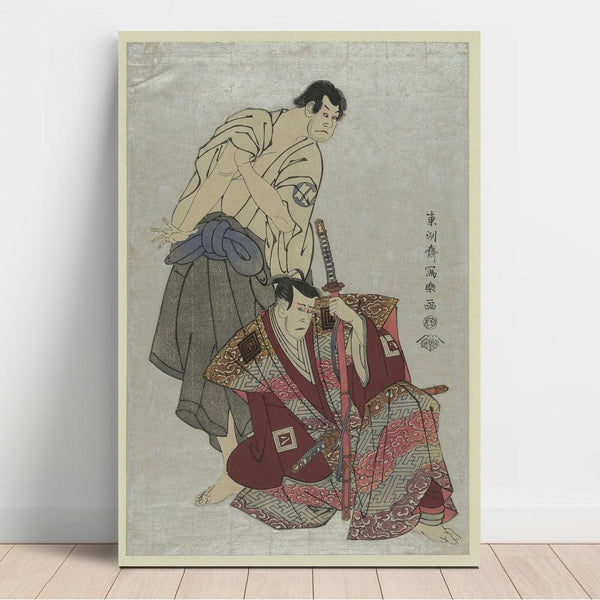
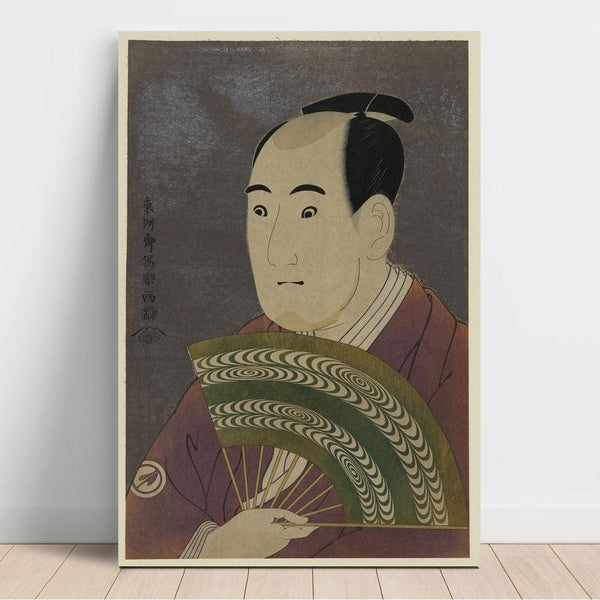
Sharaku's most famous contribution lies in his close-up portraits, or ōkubi-e, which isolate the actor's face and bust to concentrate attention on the expression. Many of these prints are distinguished by their mica-dusted backgrounds, a technique known as kirazuri that gave the background a dark, mineral sheen, heightening the presence of the figure depicted. This costly process testifies to the ambition of the publisher Tsutaya Jūzaburō for these first series.

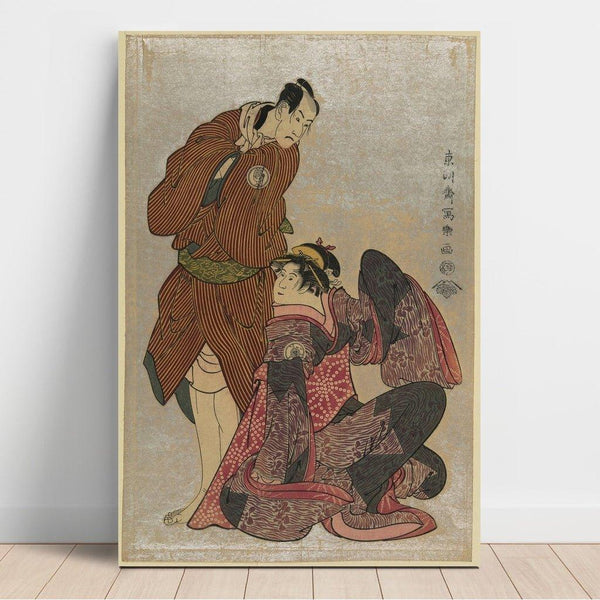
What characterises these portraits is their intensity. Sharaku captures his subjects in attitudes charged with tension, often at the moment of a theatrical gesture, and does not seek to smooth away their marked features. The furrowed brows, the clenched jaws, the hands with tensed fingers convey the emotional state of the characters embodied on stage. This frankness, sometimes perceived as unflattering in his day, contributes today to the modernity readily recognised in his work.
It should be recalled that these prints are not private portraits, but representations of actors in specific roles. Sharaku shows not an individual, but an interpretation: that of a performer taking on a character, in a given play. This dimension explains the theatricality of the poses and the richness of the expressions, which make each plate at once a document on late eighteenth-century kabuki and an autonomous work of art.
Works that endure through time

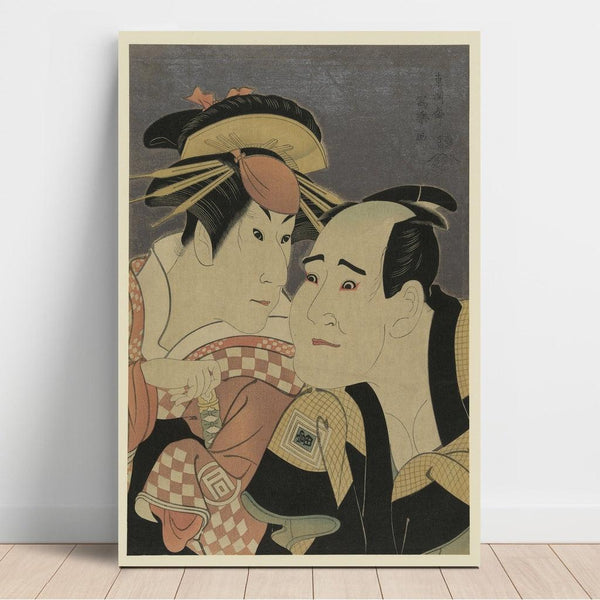
Among the prints attributed to Sharaku is the portrait of the actor Nakamura Kumetarō II in the role of Minato, the wife of Yura Hyōgonosuke, a characteristic example of the way the artist treated female roles which were, according to kabuki custom, played by male actors. This type of representation illustrates Sharaku's ability to render the grace of a character while preserving the precision of observation that is his signature.
Other compositions extend this exploration of the theatrical repertoire. The portrait of the actor Matsumoto Yonesaburō, cast in the role of Shinobu posing as the courtesan Kewaizaka no Shōshō for the play evoking a tangle of tales of revenge, testifies to Sharaku's taste for complex roles, in which the performer himself plays a character in disguise. The portrait of the actor Iwai Hanshirō IV, for its part, illustrates the attention the artist paid to the great figures of the stage of his time. These two works, available as reproductions, allow one to come as close as possible to the graphic power and expressive subtlety of his art.
Despite its brevity, the career of Tōshūsai Sharaku left a lasting mark on the history of the print. Long regarded with reserve in Japan itself, his work was rediscovered and highly appreciated thereafter, notably through the eyes of Western collectors and historians, drawn to its expressive boldness. Today, Sharaku is recognised as one of the great masters of the actor portrait, and his prints remain precious witnesses to the flourishing culture of the Edo period, as much as creations of astonishing contemporary relevance.
Discover the full range of Tōshūsai Sharaku painting reproductions.