A draughtsman, poster artist and painter, Théophile Alexandre Steinlen ranks among the essential figures of Belle Époque Montmartre. Born on 10 November 1859 in Lausanne, died on 13 December 1923 in Paris and naturalised French in 1901, he gave the capital some of its most enduring images: hieratic cats, working-class silhouettes, nocturnal scenes of the Butte. His poster « Tournée du Chat Noir » (1896) remains one of the emblems of French graphic art. Behind this fame, however, unfolds an abundant and coherent body of work, nourished by daily observation, in which tenderness for animals sits alongside a constant attention to humble people.

From Lausanne to Montmartre
Arriving in Paris in 1881, the young man from Lausanne settled in Montmartre, then a village of studios and cabarets clinging to the flank of the Butte. There he was introduced to the Chat Noir, the cabaret founded by Rodolphe Salis, which brought together songwriters, poets and draughtsmen in an atmosphere of joyful defiance. It was there that he met Aristide Bruant.
This milieu decided almost everything. Steinlen found there kindred spirits, subjects and commissions; above all he asserted there a way of seeing. Montmartre was not for him a picturesque backdrop, but an observation post: he walked its streets, noted its attitudes, retained its silhouettes. Settled on the Butte, he would draw from it the substance of his drawings, his prints and his paintings for more than forty years, until his death in 1923.
« Tournée du Chat Noir », a poster become emblem
In 1896, Rodolphe Salis took his cabaret on tour outside Paris, and it fell to Steinlen to create the image of the event. The lithograph « Tournée du Chat Noir » (1896) imposes an approach of great simplicity: a hieratic black cat silhouette stands out against a golden background, while the lettering, far from being added as an afterthought, fully takes part in the composition. The animal, motionless, almost heraldic, concentrates all the force of the image; nothing distracts the eye from this frontal presence.
This economy of means explains the poster's success. Legible from a distance, memorable at a single glance, it applies to the advertising format lessons drawn from Japanese printmaking: bold flat areas of colour, synthetic outline, refusal of modelling. Having become an icon of Montmartre and of the Belle Époque poster, it continues to embody, far beyond its original function, the spirit of Salis's cabaret and the graphic elegance of its author. Few images of this period have enjoyed such an afterlife: it belongs as much to the history of art as to the popular memory of Paris.

Cats, the subject of a lifetime
If the black cat of the poster became his public emblem, felines occupied first and foremost an intimate place in Steinlen's life. His Montmartre house, nicknamed "Cat's Cottage", sheltered the cats he observed tirelessly: curled-up sleep, stretches, grooming, patient watchfulness. From this daily companionship arose a repertoire of attitudes of rare accuracy, which his pencil captured in a few supple lines, without ever lapsing into sentimental anecdote.
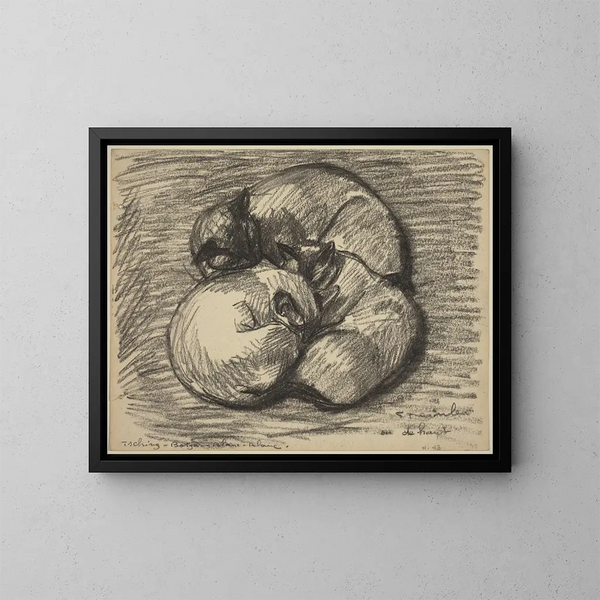
The motif quickly spilled beyond the sketchbook. For the Chat Noir, Steinlen conceived decorative panels, such as « L’Apothéose des chats », in which the familiar animal attains a monumental dimension. In a more contained register, a composition such as « Deux chats » shows what his art owes to direct observation: the supple outline and the values laid flat, characteristic of his manner, are enough to give the two felines an immediate presence. For Steinlen, the cat is neither an accessory nor a pretext: it is a full-fledged model, studied with the same seriousness as a human figure.
The draughtsman of popular life
Steinlen was first, for his contemporaries, an illustrator of exceptional fecundity. Magazines such as Gil Blas illustré, Le Mirliton and L’Assiette au beurre published his drawings by the hundreds. This regular output, far from being hackwork for a living, constitutes the heart of his work: it compelled him to look quickly and truly, to condense a situation into a single image, to let meaning be carried by the posture of a body or the tilt of a head.
His constant subject is the street and those who people it: workers, laundresses, weary passers-by, figures of urban misery. He composed these scenes not as a moralist, but as a witness who notes what he has seen, in the very streets where he lives and works. This realism is nothing like a cold assessment; it is imbued with a compassion that gives his street scenes their particular gravity. After 1914, his war drawings extended this commitment, bringing to the conflict and to those who endured it the same grave attention.
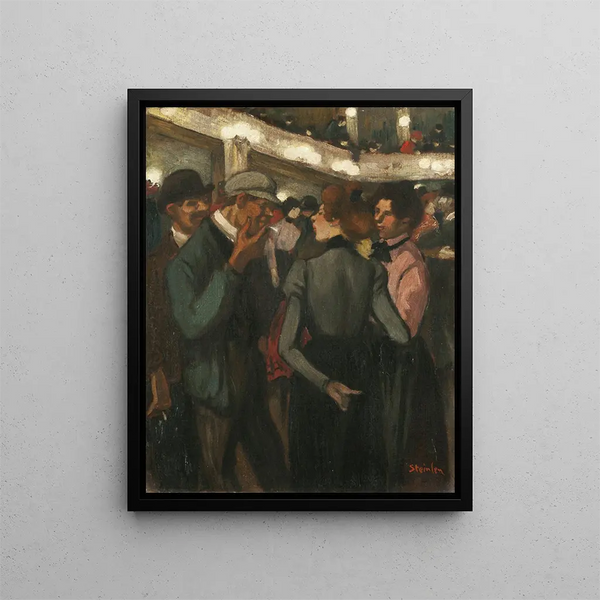
The Montmartre night belongs to the same territory. « Filles et souteneurs au Moulin Rouge », a nocturnal scene caught at the heart of the pleasure district, offers an eloquent example: there Steinlen looks at the shady world of the Butte without judging or embellishing it, with that chronicler's acuity that makes each silhouette a character. Far from the conventional splendours of the music hall, it is the humanity of the margins that holds his attention.

A recognisable graphic language
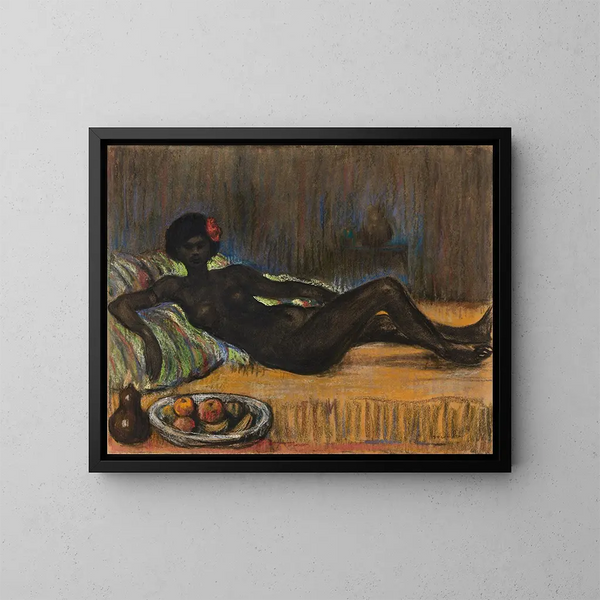
From one medium to another — drawing, lithograph, colour poster, painting — Steinlen keeps the same principles. His line is supple and synthetic: he seeks the line that sums up, not the one that details, and this discipline of the outline, acquired through years of daily drawing for the press, allows him to set down a figure or an animal in a few sure gestures. His colours are laid in flat areas inherited from Japanese printmaking, without superfluous gradations, which gives his images an immediately identifiable clarity. A work such as « Trois figures » illustrates this economy: the composition rests on the accuracy of the attitudes and on the balance of the masses, without any incidental effect.
Lithography holds a central place in this practice. A technique of the multiple image, it matched his deepest temperament: an art made to circulate, to be posted and to reach a wide public, rather than for the sole circle of connoisseurs. A photograph by the Agence Meurisse, held at the Bibliothèque nationale de France, shows him in 1913 in his studio: the image, sober, says enough about the constancy of an artist who remained faithful to his craft and to his subjects.
Living with Steinlen: formats and hanging
Steinlen's work lends itself naturally to the contemporary interior, precisely because it was designed to be seen from afar: a poster is made to hold the eye at a distance, and this original effectiveness remains intact on the wall of a living room. The bold flat areas, the crisp outlines and the coloured backgrounds converse just as well with pared-down furnishings as with a more classical décor, to which they bring a period note without heaviness. A Steinlen print does not impose a style on the room. It introduces into it a graphic signature recognisable among all, one that structures a wall without cluttering it.
The vertical format of « Tournée du Chat Noir » makes it a natural piece for an entrance hall, a corridor or a narrow stretch of wall, where its frontality produces its full effect. Feline subjects, such as « Deux chats », readily suit living spaces — living room, library, bedroom — where their silent presence accompanies daily life. Nocturnal scenes, such as « Filles et souteneurs au Moulin Rouge », suit a study or a reading nook, where their atmosphere is discovered up close.
The gallery brings together reproductions of posters and paintings by Théophile Alexandre Steinlen in several formats — « Deux chats » exists notably as a framed reproduction — which allows the scale of the image to be adjusted to the wall that receives it. A sober frame, black moulding or light wood, is enough: these images carry their own graphic design within them and need no decorative reinforcement. Hung at eye level, alone or in a small group, they recover in our interiors the function that was once theirs: to stop the passer-by, and to stay in their memory.