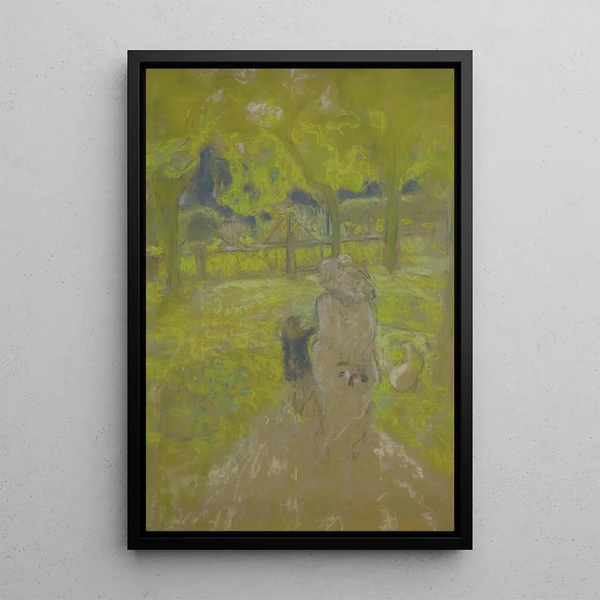
Few painters have known how to listen to the silence of a lived-in room quite like Édouard Vuillard. Born on 11 November 1868 in Cuiseaux, in the Saône-et-Loire, then settled in Paris with his family, he grew up in a studio apartment where his mother worked as a corset-maker. Fabrics, wallpapers, stacked cloths and the muted light of modest interiors became the raw material of his eye. From this childhood spent among patterns and subdued colours came an intimist art, attentive to ordinary gestures. A major figure of the Nabis, who died on 21 June 1940 in La Baule, Vuillard remains the painter of the home and its quiet.

The reproductions of Édouard Vuillard's paintings now make it possible to recapture this very particular atmosphere, one of restraint and muffled harmonies, where every surface becomes a plane of colour and every figure seems absorbed in its task.
A Parisian training and decisive friendships
It was at the Lycée Condorcet in Paris that the network of friendships which would accompany Vuillard's entire career took shape. There he met Ker-Xavier Roussel, who would become his brother-in-law, as well as Maurice Denis and Aurélien Lugné-Poe, the future man of the theatre. These youthful bonds would never come undone: they mapped out the artistic and intellectual circle in which the painter moved.
After secondary school, Vuillard studied at the Académie Julian, then passed briefly through the École des Beaux-Arts. He absorbed this classical training without letting it confine him. Very quickly, the question that occupied him was no longer that of likeness or academic modelling, but that of the painted surface, its organisation, the way colours harmonise with one another. The painting ceased to be a window and became a decorative object in its own right, conceived as a composition of flat areas of colour and rhythms.
The Nabis and the art of the surface
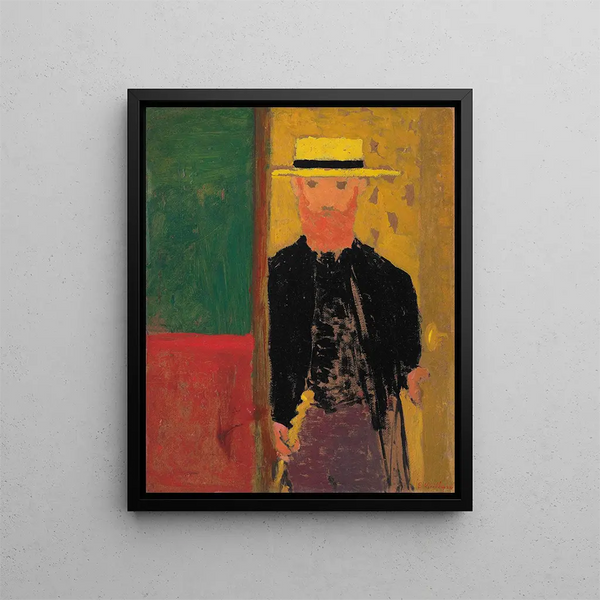
Around 1888-1890, Vuillard was among the founding members of the Nabis, alongside Pierre Bonnard, Maurice Denis, Paul Sérusier and Ker-Xavier Roussel. The group's name, borrowed from Hebrew, means 'prophets': it says enough about their ambition to renew painting, to give it a new scope. Their aesthetic rested on clear principles. Volume gave way to the flat area of colour, space became flat, illusionistic depth receded. Surfaces turned decorative, harmonies stayed muted, deliberately restrained.

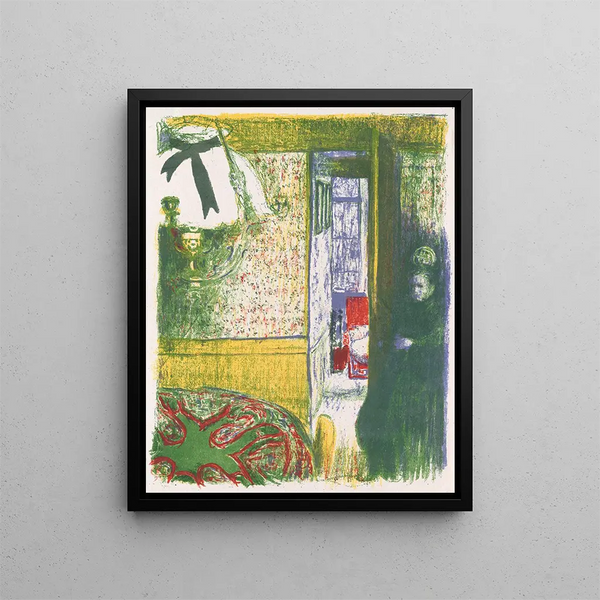
This manner owed much to the Japanese print, whose japonisme was then running through an entire generation of Parisian painters. In Vuillard's work, this influence translated into tight framing, motifs that overrun the field, a keen attention to textures. A flowered wallpaper, a polka-dot dress, a patterned rug are not mere accessories: they take full part in the construction of the painting, whose visual rhythm they determine. Figure and setting sometimes blend to the point of merging, as if caught in one and the same coloured weave.
Here one can measure all that Vuillard owed to his childhood. The studio apartment of his corset-maker mother, its lengths of fabric, its wallpapers and its samples shaped a sensibility for which a printed motif was worth as much as a face. The painter sought not effect, but the right accord. His harmonies stayed deliberately low, almost whispered, as if he feared to disturb the calm of the places he observed. This economy of means, this refusal of brilliance, lastingly set his manner apart from that of many painters of his time.
Intimism: the silence of rooms
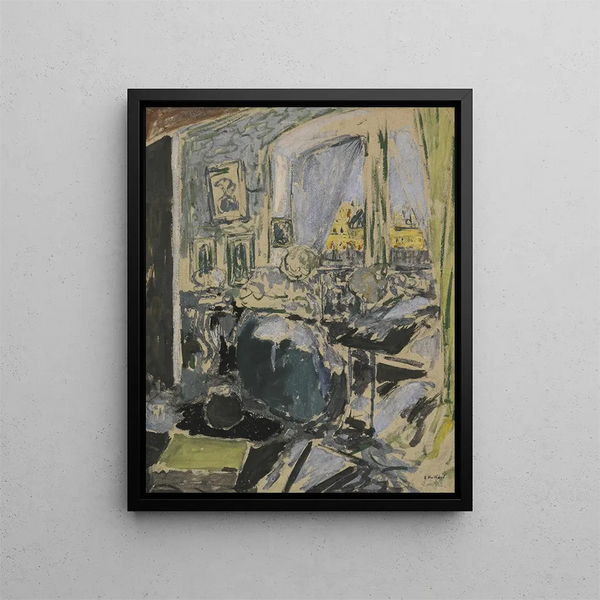
It is in domestic interiors that Vuillard's genius finds its fullest expression. Intimism is the name given to this painting of the indoors, of enclosed rooms where figures lose themselves in a task: sewing, reading, tidying, keeping watch. The light there is hushed, softened by curtains and papered walls. Nothing raises its voice. A silence seems to inhabit these bedrooms and drawing rooms, a silence that painting makes almost palpable.
The painting 'In Bed', made in 1891 and held at the Musée d'Orsay, pushes this exploration to a form of abstraction. The composition is radically simplified: a few planes, a reduced range of whites and greys, a reclining figure pared down to the essential. Vuillard shows here that the most modest of subjects, a sleeper's rest, can give rise to a pictorial organisation of great rigour. Simplification does not impoverish the scene; it concentrates its emotion, bringing it back to a silent meditation on light and repose.
This intimist vein runs through two works that the Artem Legrand gallery offers in reproduction. Women Sewing shows figures bent over their work, absorbed in the patient movement of the needle, surrounded by fabrics and patterns that recall the corset-making workshop of the painter's mother. Children Reading, for its part, captures that moment of quiet concentration when the world narrows to the open page. In both cases, the domestic scene becomes a motif worthy of attention, treated with the same chromatic delicacy.

Decorative panels, theatre and photography
Vuillard was not only the painter of small, intimate formats. He also took on large scale with the decorative panels of 'Public Gardens', painted in 1894 for a commission from Alexandre Natanson. These vast surfaces transpose the Nabi vocabulary to the scale of a wall: flat areas of colour, cut-out silhouettes, harmonies of greens and muted tones, figures of children and strolling women in the light of a park. Here the painter proves that his art of the decorative surface can inhabit an entire wall without losing any of its subtlety.
His ties with the Natanson family led him to work for La Revue blanche, a hub of the artistic and literary life of his time. The theatre occupied him too: he designed programmes and sets for the Théâtre de l'Œuvre, the stage run by his friend Lugné-Poe. From the late 1890s onward, Vuillard also took up photography. Armed with a small Kodak camera, he took snapshots of those around him, catching on the spot the postures and moods that in turn fed his painting. This practice of quick framing, made of unexpected angles and figures caught mid-gesture, resonates with his intimist paintings, where the domestic moment too seems captured on the fly.
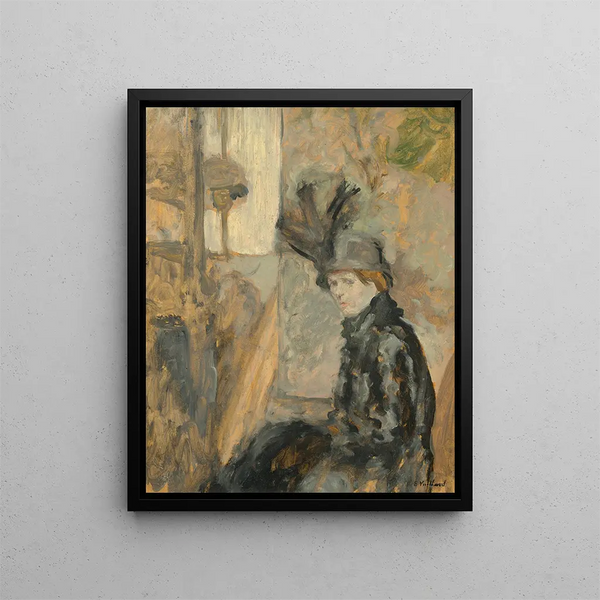
His late work moved towards a more assertive naturalism. The painter became a portraitist of the society of his day, an attentive observer of faces and bourgeois interiors. This recognition culminated in 1938 with his election to the Académie des Beaux-Arts, the official and belated crowning of a career led first far from honours, in constant fidelity to the most modest of subjects.
Living with a work by Vuillard
Few paintings sit as naturally within an interior as Vuillard's, since they are themselves interior scenes. Their muted harmonies, their soft greys, their muffled greens and their woven beiges converse effortlessly with a lived-in wall. A reproduction such as 'Women Sewing' or 'Children Reading' finds its place in a living room, a library or a bedroom, anywhere one seeks a discreet presence rather than a display.
These compositions love soft light. Kept away from direct sunlight, on a wall of neutral or slightly warm tone, they reveal the fineness of their colour transitions. A medium format, at eye level, suits these scenes, which ask that one come close to read their patterns. They can also be brought together in a small hanging, two or three neighbouring works, to recover the sensation of a succession of lived-in rooms. Arranged in this way, Vuillard's painting extends the domestic space instead of breaking it, and invites, each day, that moment of attentive calm which it made its subject.