Christian Rohlfs holds a singular place in the history of German painting. Born in 1849 and trained in the tradition of the nineteenth century, he was nonetheless one of those artists who, at an age when many are content to repeat their established formulas, managed to evolve their language all the way to the shores of Expressionism. His trajectory, which passes through naturalism, impressionism and then an increasingly free expression of colour, makes him an essential transitional figure for understanding the shift from academic painting to modernity. This article looks back over his career, his notable works and the place occupied by his landscapes, today accessible to the public in the form of reproductions.
A singular path towards Expressionism
Christian Rohlfs was born on 22 December 1849 in Holstein, in the north of Germany. His youth was marked by a serious ailment of the leg that left him immobilised for a long period and upended the course of his life. It was partly during this convalescence that he turned to drawing, before undertaking an artistic training. He studied at the fine arts school in Weimar, then an important centre of German painting, where he first embraced a practice attentive to the observation of nature.
His earliest works belong to a measured naturalism, soon inflected by his discovery of impressionism. Rohlfs took an interest in the variations of light, in the vibration of the atmosphere, in the way a brushstroke can convey the instability of the visible world. This curiosity never left him: far from settling into a single manner, he remained attentive to the currents running through European art, from post-impressionism to bolder investigations of colour. This intellectual openness explains why, at an advanced age, he was still able to renew his work profoundly.

Colour and matter at the heart of the work
From the 1900s onwards, Rohlfs's painting gradually freed itself from description in favour of chromatic intensity and expression. His encounter with the artistic circle gathered around the collector and patron Karl Ernst Osthaus, founder of the Folkwang Museum in Hagen, played a decisive role: Rohlfs settled in that city in 1901 and found there an environment conducive to experimentation. Contact with artists of the rising generation, among them Emil Nolde, encouraged him to push the autonomy of colour still further.
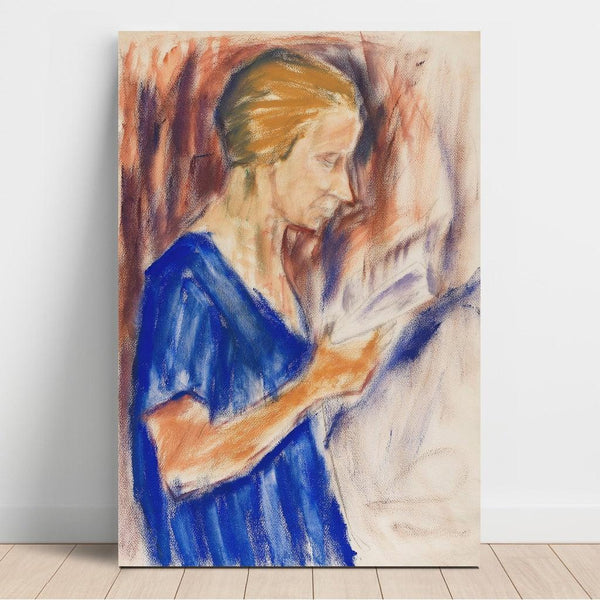
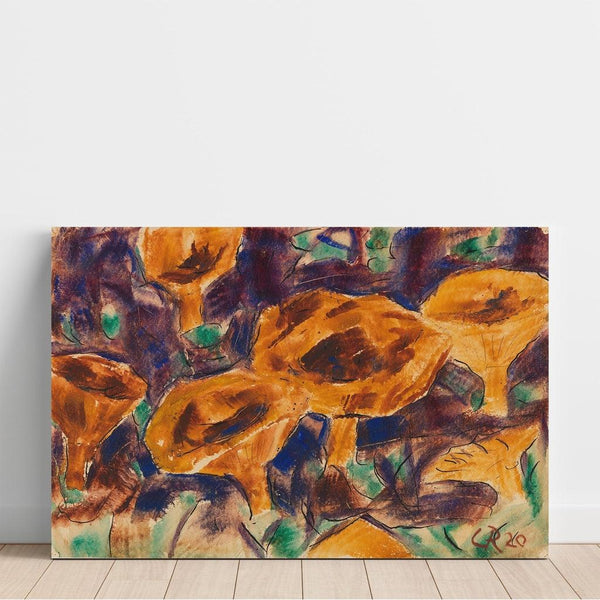
Technically, Rohlfs developed an original practice, notably in his use of tempera and watercolour. He worked the material, scraped it, layered and removed colour, obtaining surfaces where the light seems to well up from within the painting. This exploration gives his compositions a recognisable texture, between transparency and density. Works such as Poverty (Pauvreté), dated 1919, testify to an expressive and human dimension that the artist knew how to approach without emphasis, through the sheer eloquence of form and tone.

For Rohlfs, the subject is never a purely decorative pretext. Whether he paints an architectural structure, a figure or a plant motif, he seeks to draw out a presence, an emotional charge that goes beyond mere likeness. It is this tension between observation and transposition that gradually brings his work closer to Expressionism, a movement of which, through his freedom, he became one of the oldest and most respected representatives.
Landscapes and rootedness, from Weimar to Hagen
Landscape is one of the guiding threads of Rohlfs's work. The regions where he lived and worked, from Thuringia around Weimar to Westphalia around Hagen, nourished a significant part of his output. Wooded heights, forest edges, paths sinking into the countryside became recurring motifs, pretexts for an exploration of colour and light. A work such as The Road to Gelmeroda, which refers to a village near Weimar, illustrates this attachment to familiar landscapes, transfigured by the painter's gaze.

In this vein, paintings such as the Forest or Pines on the Ettersberg, today offered as reproductions, reveal the way Rohlfs approaches nature. The Ettersberg, a hill near Weimar, offers a motif of wooded slopes where the artist can deploy his palette and his brushwork. Far from topographical description, these views favour the overall impression, the balance of coloured masses, the rhythm of the trunks and foliage. The forest, an old motif of German painting, finds here a resolutely modern reading.
These landscapes also express a certain idea of one's relationship to place. Rohlfs does not seek the exotic or the spectacular; he draws from a nearby environment the substance of an ambitious painting. This economy of means, this fidelity to modest motifs treated with great intensity, contribute to the coherence of his work and to its ability to move the viewer of today.
A thwarted then acknowledged legacy

During his lifetime, Christian Rohlfs enjoyed growing recognition, punctuated by exhibitions and distinctions. His creative longevity allowed him to span several pivotal decades of European art. However, the final years of his life were darkened by the German political context: under the National Socialist regime, his work was targeted by the campaign against so-called degenerate art, and many of his paintings were removed from public collections. The artist died in 1938 in Hagen, the city that had accompanied an essential part of his career.
This eclipse was only temporary. The recognition of Rohlfs as one of the pioneers of German Expressionism grew stronger over the course of the twentieth century, championed by museums and art historians alert to the richness and originality of his approach. His ability to combine a deep pictorial culture with a late-blooming audacity continues to draw the interest of enthusiasts and scholars alike.
To discover Rohlfs today is to gauge how much modernity was also a matter of perseverance and patient renewal. His landscapes, his forests and his views of the hills around Weimar retain a quiet strength that lends itself particularly well to contemplation at home. Reproductions of his works thus offer the chance to bring into one's home a part of this history of art, between rigour of composition and freedom of colour.
Explore the full range of Christian Rohlfs painting reproductions.