Few artists of the early twentieth century observed the industrial world with as much calm and rigour as Carl Grossberg. Associated with the German New Objectivity, this painter born in 1894 made factories, machines and modern architecture the heart of his work. Where others celebrated speed or denounced alienation, he chose exactitude: an even light, crisp volumes, a controlled coolness that lends technical apparatus an almost silent presence. To understand his work is to revisit the moment when European painting took stock of the age of the machine without giving up the clarity of drawing.
A path between engineering and painting
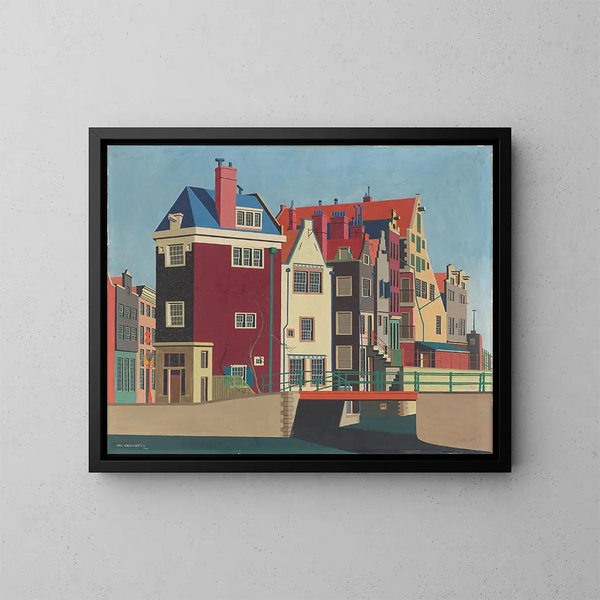
Carl Grossberg was born in 1894 in Elberfeld, today a district of Wuppertal, in an industrial Germany in full expansion. His initial training did not immediately point him towards painting: he first turned to architecture, a discipline that would leave a lasting imprint on the way he composed. A taste for structure, attention to proportion and to the rational construction of space run through all his later work. This culture of the built environment partly explains why his paintings often read like inhabited plans, where each element occupies its place with geometric self-evidence.
After the First World War, Grossberg turned to the arts and studied at the Bauhaus in Weimar, in the circle of the painter Lyonel Feininger. This passage through the institution founded in 1919 brought him into contact with the formal research of his time, between constructive rigour and modern sensibility. He took from it less an abstract grammar than a demand for clarity. Gradually, he developed a personal language, at a remove from the most radical avant-gardes, founded on the patient description of reality rather than on its decomposition.

New Objectivity and the gaze upon the machine
In the 1920s, Germany saw the rise of New Objectivity (Neue Sachlichkeit), a movement that answered Expressionism with a return to the real, to lucid observation and to precise drawing. Grossberg belongs to it through his careful craftsmanship and his refusal of pathos. His favourite subject is the technical world: factory interiors, boilers, piping, machines and industrial landscapes. He treats them with an apparent objectivity, a steady light and a restrained palette, which give these environments an unexpected dignity.
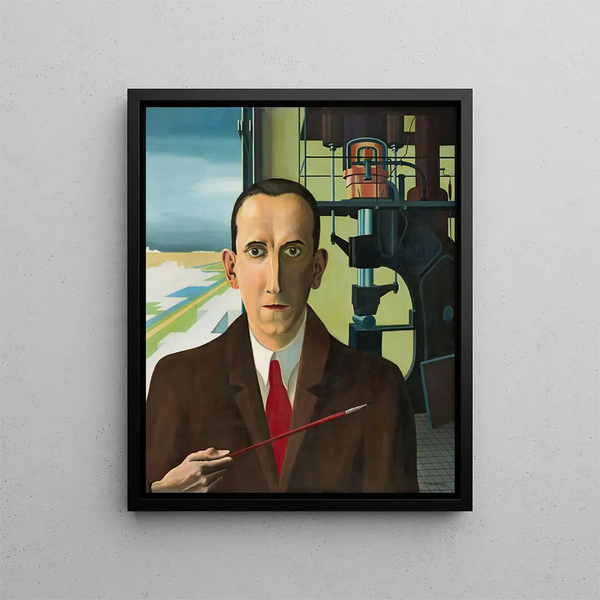
What sets Grossberg apart is the tone of his gaze. His workshops and mechanical installations are often empty of human presence, which heightens the sense of order and sometimes of strangeness. The machine becomes a subject in its own right, contemplated for its forms, its curves, its interplay of pipework and metallic surfaces. This cool attention brings some of his compositions close to an almost magic realism, where the precision of the rendering lends the industrial ordinary an aura of silence and mystery.

The painter does not illustrate a social thesis: he records, methodically, the physiognomy of a new world. In this he belongs fully to his generation, the one that, between the two wars, sought to grasp modern reality in what was concrete and constructive about it. His painting bears witness to a confidence in form, in line and in controlled colour, as so many instruments for making intelligible the complexity of the installations he depicts.
Composition with Turbine and the industrial works
Among Grossberg's recurring motifs, the turbine, the boiler and mechanical apparatus hold a central place. A work such as Composition with Turbine sums up his ambition: to make the technical component the protagonist of a painting, isolating it, framing it and lighting it as one would a monumental still life. There the turbine loses its purely utilitarian function to become a pure form, a metallic architecture whose logic and balance the painter underlines.

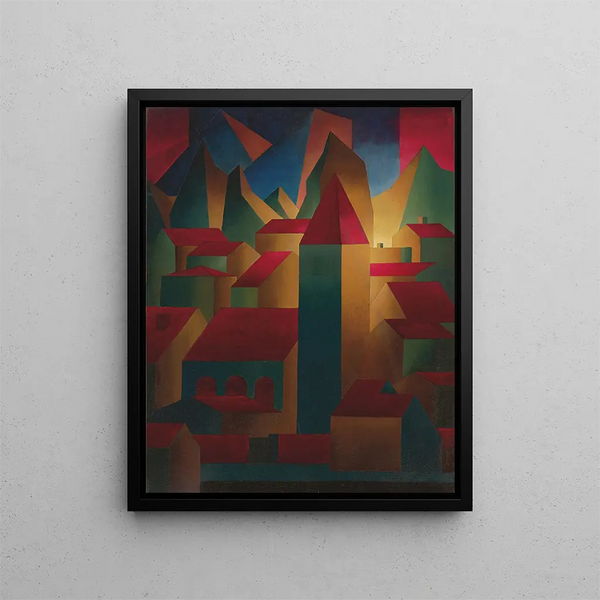
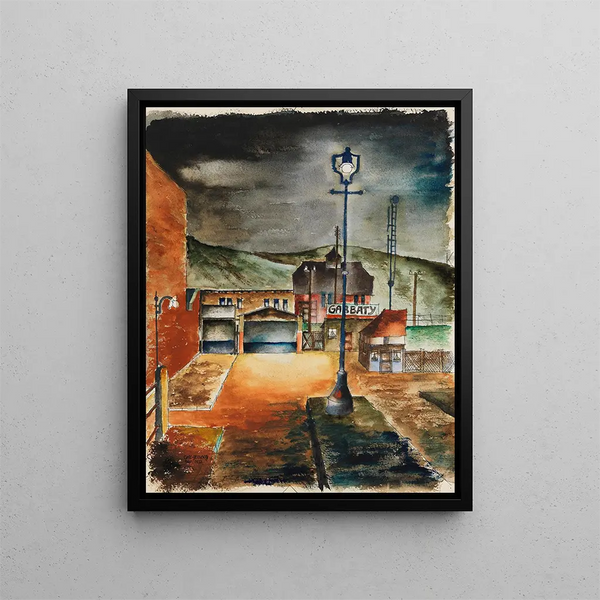
This approach is found again in his views of refineries and industrial installations, where the tangle of pipes, tanks and walkways is ordered by a firm composition. The reproduction of the painting Refinery illustrates this manner well: the space is structured with an engineer's rigour, the colour remains sober, and the whole gives off an impression of concentrated calm. Likewise, a composition such as Untitled, offered as a reproduction, reveals the constancy of an artist devoted to clarity of volume and accuracy of line. These images appeal today as much for their documentary quality as for their silent formal beauty.
A discreet but lasting legacy
Carl Grossberg's career was cut short prematurely: he died in 1940, in France, during the Second World War. This early death no doubt limited the immediate spread of his name, less famous than those of other figures of New Objectivity. Yet his work has retained a singular place in the history of German painting between the wars, precisely because it offers a rare synthesis of technical culture and pictorial rigour.

The renewed interest in New Objectivity over recent decades has brought his contribution back into the light. Grossberg appears as one of the painters who knew how to look at industry without nostalgia or naïve fascination, as an attentive observer of his era. His paintings of factories and machines resonate with contemporary questions about the place of technology in our lives, while offering the timeless pleasure of a rigorous composition and a perfectly held light.
To rediscover Carl Grossberg is thus to reach a painting that reconciles the eye of the engineer with that of the artist. His world, made of precise volumes and restrained atmospheres, continues to captivate lovers of modern art. Reproductions of his works allow their presence to be prolonged, inviting everyone to consider, as the painter did with such constancy, the share of form and silence that the industrial world holds.
Discover all the Carl Grossberg painting reproductions.